Act reliably
Our Annual Report
Act reliably
Our Annual Report
Press Release
Corporate news

Vonovia’s core business is the provision of housing that meets everyone’s needs. Our main challenge is to supply housing at fair and transparent prices while simultaneously achieving a a greenhouse gas-neutral housing stock (for details of the implementation plan, see the Annual Report). Discover how we are working towards our goal of providing homes for everyone by ensuring strict compliance with all regulatory requirements and implementing transparent, socially responsible measures.
To measure our contribution to affordable housing, we use three key performance indicators: the average rent per square meter, the number of rent-controlled apartments, and—in Germany—the average allocation of modernization costs to tenants.
These indicators serve as benchmarks for comparing our performance within the industry and provide transparency regarding our responsible approach to rent setting. In addition, we use the planned organic rental growth for the following year as a supplementary indicator.
We align our energy‑efficient modernisation measures with the climate targets presented in the annual report and in the transition plan for climate action, while at the same time taking into account the rent burden of our customers.
As a responsible housing company, we provide affordable, needs-based housing and help meet one of society's most fundamental needs—a place to call home. Our objective is to offer as many people as possible a secure, long-term housing perspective, even under challenging market conditions, while continuing to pursue our pathway toward a climate-neutral residential portfolio by 2045 (see the implementation plan in the Annual Report for further details).
To achieve this, we align our rents with local market conditions and officially recognized rent indices, placing particular emphasis on affordability, social responsibility, and transparency. We invest in the letting, modernization, and development of residential properties, make use of public funding programs, and work closely with cities and municipalities to create new housing, including subsidized homes.
Additional measures—including hardship support, social management services, dedicated arrangements for older residents, and the work of our social managers—help low-income and particularly vulnerable households remain in their homes over the long term.
Strategic decisions regarding our letting approach are made by the Management Board, while implementation is carried out locally by our regional organizations under the responsibility of the Chief Rental Officer (CRO).
Despite the continued shortage of housing and challenging market conditions, we remain committed to providing homes at transparent and fair prices that are affordable for people with different financial circumstances.
Our rents are based on local market conditions and, where available, officially recognized rent indices. As of 31 December 2025, the average rent across the Group was €8.38 per square metre (€8.19 per square metre in Germany), representing an organic rental growth of 4.1% compared with the previous year. Index-linked leases—where rents are adjusted in line with inflation—account for only around 2% of our tenancy agreements. Across our portfolio, the average total housing cost (including service charges) remains below 30% of the average disposable household income of tenant households in Germany.
We support appropriate regulatory measures in housing markets, as we believe they help maintain social balance and contribute to a stable business environment. In all countries in which we operate, our letting practices fully comply with the applicable national legislation.
In Sweden, rents are generally determined through binding negotiations between tenants' associations and landlords and are therefore subject to rent regulation. Rent adjustments are typically agreed on an annual basis and may also be made following modernization measures that improve the standard of a property.
In Germany, part of the cost of energy-efficiency modernization may, within the limits set by law, be allocated to the basic rent. Legislation caps this allocation at €3 per square metre (or €2 per square metre for homes with rents below €7 per square metre). At Vonovia, the average allocation of modernization costs in 2025 amounted to €0.75 per square metre.
Our business model ensures that we are always integrated into the urban society where we offer homes. Cities and municipalities are therefore our most important partners when it comes to the concrete design of our local residential offerings.
In numerous cities and municipalities, we also offer subsidized and independently financed homes for people on low incomes – in Germany around 27,000 of our homes are currently price-controlled – and are responding to specific challenges with services tailored to local needs. The supplementary voluntary agreements that we conclude with municipal authorities include, for example, provisions governing fair rental conditions, the construction of new apartments or the strengthening of municipal housing construction companies and joint neighborhood development.
We also offer price-controlled homes, in particular in Austria and Sweden. Almost 18,400 (>90%) apartments in Austria and all of our approximately 40,000 apartments in Sweden are price-controlled. In total, around 16% of our entire portfolio is therefore subject to rent caps.
The fundamental concept on which all agreements are based is Vonovia’s desire to work in partnership with politicians and society to tackle municipal challenges and that the company takes specific local and social challenges present within cities into account within its planning.
At Vonovia, we take a comprehensive approach to social support, providing our customers with a reliable safety net. Our primary objective is to help residents maintain their financial stability so they can remain in their homes and continue to afford their housing.
To achieve this, we offer a range of tailored support measures, including rent deferrals, installment payment arrangements, assistance with housing benefit applications, and relocation support where appropriate. These services are delivered by a dedicated team of specially trained social managers.
As part of our hardship policy for modernization projects, we apply uniform standards based on guidance developed by leading social welfare organizations. These standards were established jointly with the German Tenants' Association and other housing companies to ensure consistency, fairness, and transparency in hardship cases. In recent years, we have been able to achieve positive outcomes in the vast majority of hardship claims, providing direct support to the affected customers.
We also continue to uphold our special protection policy for residents aged 70 and over.
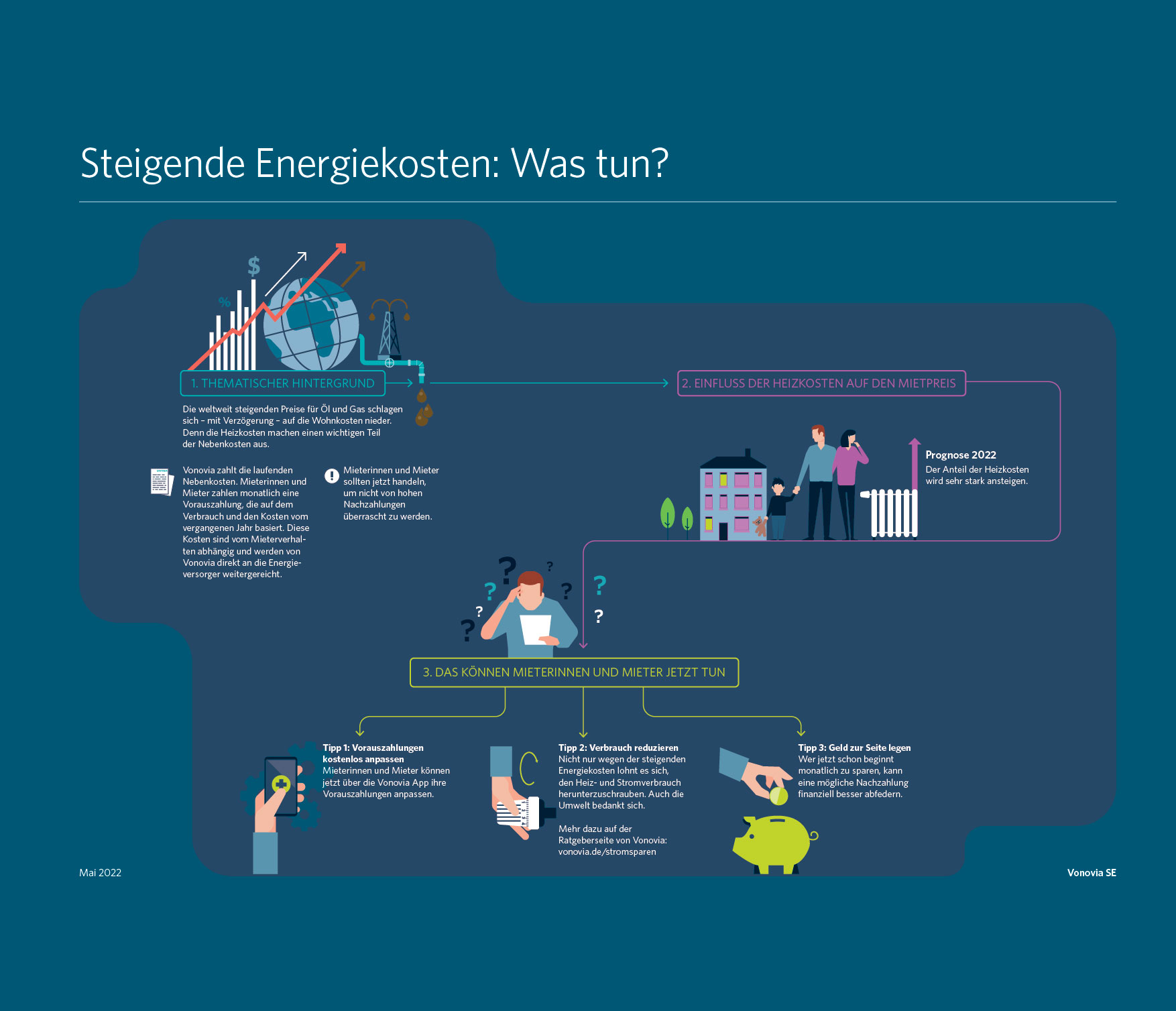
A particular source of financial strain for many households has emerged in recent years as a result of ongoing geopolitical conflicts and crises – in the form of a sharp rise in energy costs (especially for heating). Even though we are generally not the energy supplier ourselves, but rather only pass on the costs charged by the energy providers concerned, we consider it our responsibility to support our tenants.
With this in mind, we have developed a comprehensive package of measures to counteract – within our possibilities – the increase in costs caused by the energy crisis and inflation. These include reducing the nighttime temperature in our properties by one degree Celsius to save energy, energy-saving tips, help with claiming government benefits and individual solutions when tenants find themselves unable to cover energy costs. We provide our tenants with information about how to save energy in various languages, including on our website.
Energy prices have also risen dramatically in Sweden over the past few years. Due to the Swedish model of rents that already include ancillary costs, however, tenants only have to bear the price effect associated with electricity themselves, while landlords’ ancillary costs are on the rise due to the higher heat supply costs. However, this simultaneously provides incentives for energy-efficient building refurbishment. We have not yet identified any critical changes due to energy prices affecting customers.
A key concern for Vonovia is ensuring that all people can access housing without facing discrimination in accordance with the German General Act on Equal Treatment (AGG) and fundamental human rights.
In a pluralistic, democratic society, fair and transparent access to homes is essential. Our residential offerings and services are therefore low-barrier and generally accessible; we word our housing advertisements and rental contracts using neutral language to prevent discrimination.
When processing housing applications, we take considerable care to ensure that our allocation procedures are transparent and fair. Allocating apartments in a socially mindful way helps to achieve stable social harmony and contributes to people’s well-being in our neighborhoods.
Furthermore, we foster an open anti-discrimination culture that is actively supported and promoted by the company’s top-level management. Our multilingual whistleblowing channels, which are also available to all tenants, can be used to report suspected cases of discrimination openly or anonymously. The purpose of this is to ensure that our values are practiced in all aspects of providing a home – from the application to the tenancy itself to moving out.
We aim to ensure that no one finds themselves at a disadvantage due to their social background or other personal characteristics. Housing is a human right, and we are committed to safeguarding this right for everyone.
We’re not only interested in protecting the especially vulnerable when it comes to making homes available to particular target groups. To support the mobility transition and contribute to the stability of an important component of the country’s infrastructure, Vonovia also cooperates with Deutsche Bahn.
The railway company’s employees can rent homes from us at favorable conditions. The aim is to give the company’s train conductors, drivers and technicians the opportunity to find affordable and appealing homes near their place of work.
In the future, we aim to expand our network of partners and explore collaborations with other professional groups.
The aim of so-called ‘green leases’ is to contractually agree on resource conservation and climate protection between landlords and tenants. This instrument, which is mainly used for commercial properties in the English-speaking world, is intended to promote sustainable behavior - over and above the low legal standards in some areas.
Typical elements of green leases include transparency regarding consumption data, the use of renewable energies, the conservation of resources (energy and water) and the environmentally friendly and resource-conserving implementation of construction and repair measures.
This concept cannot be applied to the German housing sector to the same extent—and there is no need for it. In our rental relationships, we ensure comprehensive transparency regarding consumption data and the energy condition of the property – for example through billing data and energy performance certificates. In our modernisation and maintenance activities, we follow the applicable legal requirements as well as internal technical standards, for instance with regard to energy efficiency and material quality (see transition plan for climate action). Germany's robust regulatory framework provides an additional layer of assurance.
Through our climate pathway and the measures associated with it—including the provision of certified green electricity—we contribute to the decarbonization of the residential building stock (for details on our implementation plan, see the Annual Report). The legally defined allocation of eligible modernization costs through rents provides transparency, predictability, and planning certainty for future rental developments.
Our tenancy agreements therefore fulfil all the key characteristics of a ‘green lease’.
For more information, we recommend the ZIA brochure ‘Green Lease 2.0’ (German).