Act reliably
Our Annual Report
Act reliably
Our Annual Report
Press Release
Corporate news

Through our new construction activities, we are creating additional, affordable housing, particularly in metropolitan areas. As a large residential company, we assess both the economic viability and the energy-related and resource-related requirements of new-build and conversion projects and develop appropriate concepts.
For our new-build and conversion projects, we place particular emphasis on the design of the building envelope and the potential use of energy from renewable sources. We also focus on construction methods that require fewer building materials and make efficient use of available space. An important approach to reducing resource demand is the use of modular construction and refurbishment solutions.
In addition, the development and planning of use-neutral floor plans that are suitable for different lifestyles, as well as the construction of barrier-reduced housing types, play an important role.
Key performance indicators and target achievement: The most important non-financial performance indicator in Development is the average primary energy demand of newly constructed buildings per square metre of rental space. This key figure is also part of the Sustainability Performance Index (SPI). In 2025, the average primary energy demand was 21.9 kWh/m².
Medium Target (2030): By 2030, we aim to limit the average primary energy demand of new builds to around 25 kWh/m². In the longer term, energy demand and CO₂ intensity, including the embodied emissions of new construction, are expected to decrease further.
Our subsidiary BUWOG is responsible for Vonovia’s development business and develops residential neighbourhoods in Germany and Austria. As part of the development of our existing neighbourhoods, BUWOG also undertakes densification projects. Our focus is on developing large inner-city sites in major cities (so-called brownfield projects) in order to create additional housing while at the same time limiting further land take. With our new-build and conversion projects, we provide housing that is designed for low energy demand and can be made more robust against climate-related impacts. In doing so, we respond to the growing demand for housing, which can also influence rental income and the valuation of our properties.
The development business in Germany and Austria is overseen by the Chief Development Officer (CDO), while all development projects are approved by the Executive Board.
The Development segment has a dedicated sustainability strategy tailored to its specific requirements, comprising 14 focus areas that provide guidelines, specifications and tools for the planning and construction of neighbourhoods. These include, among other things, requirements for heat supply within the neighbourhood, the selection of building materials with defined environmental profiles and the design of outdoor spaces taking climate and site conditions into account. The starting point is the objective of outperforming the legally required efficiency house standard in Germany by at least 10%, or of meeting the klimaaktiv criteria in Austria. Through our Building Information Modelling (BIM) strategy, we gain insights into the life cycle of our neighbourhoods, which we use as a basis for deriving further measures.
At the same time, changing economic and regulatory conditions can increase development and construction costs, potentially making projects less economically viable. To mitigate such risks, we rely, among other things, on construction methods such as serial and modular building.
We focus on revitalising urban sites (brownfield projects) in order to conserve undeveloped land. Projects in cities such as Hanau and Berlin show how we transform sealed industrial areas into green residential neighbourhoods – for example through large-scale unsealing measures at Münsterberger Weg.
In parallel, we are driving digitalisation by applying the Building Information Modelling (BIM) method across countries. A uniform Group strategy links our German and Austrian units to better coordinate planning and construction processes and make the use of resources more transparent.
In the Development segment, defined environmental and climate protection aspects are embedded as a standard process in project planning. Dedicated tools ensure that, for new-build projects, topics such as energy demand, land sealing, greening and rainwater management are taken into account from the initial planning stage through to subsequent monitoring and are documented in the project standards.
In our new-build and conversion projects, we place particular emphasis on the energy performance of buildings and the potential use of energy from renewable sources. The basis for this includes, among other things, German efficiency house standards and the new-build criteria of Austria’s “klimaaktiv Pakt”.
We manage the development of energy demand in our new builds essentially through two approaches: firstly, by applying high insulation standards combined with predominantly district heating supply with a low primary energy factor; and secondly, by increasing the use of air-to-water heat pumps in combination with photovoltaic systems. In some projects, more than 55% of heat and hot water demand is already covered by renewable energies. In Austria, no new-build projects have been realised with gas-based heat supply since 2022.
Numerous projects meet the criteria of the state quality label for sustainable buildings (QNG), which is a prerequisite for accessing funding under the “climate-friendly new-build” (KFN) programme.
In the residential building sector, building certifications play only a minor role. For existing buildings, we therefore focus on energy efficiency classes. For new construction, we use building certifications on a needs-based basis. Numerous projects meet the criteria for the government’s “Sustainable Buildings” (QNG) quality seal, which is a prerequisite for receiving the “Climate-Friendly New Construction” (KFN) subsidy. Alternatively, we also have projects certified according to DGNB or ÖGNI standards.
In our new-build and conversion projects, we examine how to limit the use of new, energy- and resource-intensive materials. We increasingly rely on building materials that can be reused or recycled and whose material properties are documented over their life cycle. At all stages of our construction projects, we take into account requirements for raw material selection, production processes and construction methods that are designed to make the use of materials plannable and to keep material flows traceable.
The circularity of materials is playing an increasingly important role. Our objective is to select and combine building products in such a way that components can be dismantled and materials used in further applications or recovered as raw materials. Construction methods such as timber modular or hybrid structures facilitate subsequent dismantling and enable load-bearing systems that can be designed for limited energy demand and defined emissions profiles.
Life cycle analyses are already used at the planning stage to assess the greenhouse-gas-related emissions of building materials across manufacturing, use and end-of-life. In addition, we design use-neutral floor plans that allow flexible adaptations – for example, the conversion of apartments for alternative uses. Our life cycle, overall-mass circularity tool (ÖBIGK) supports the early assessment of material quantities and the potential for reuse and recycling in line with ISO 20887.
We employ innovative methods to standardise construction processes and make costs and resource requirements more predictable. This also includes a strategic partnership with GROPYUS AG, whose platform-based solution in modular, prefabricated timber-hybrid construction aims for high economic efficiency and lower resource use compared with conventional construction methods.
To develop new materials and building products, we have conducted an innovation competition as part of the “Perspectives on the Future of Construction” dialogue process, in which material- and product-related solutions for use in residential construction were recognised.
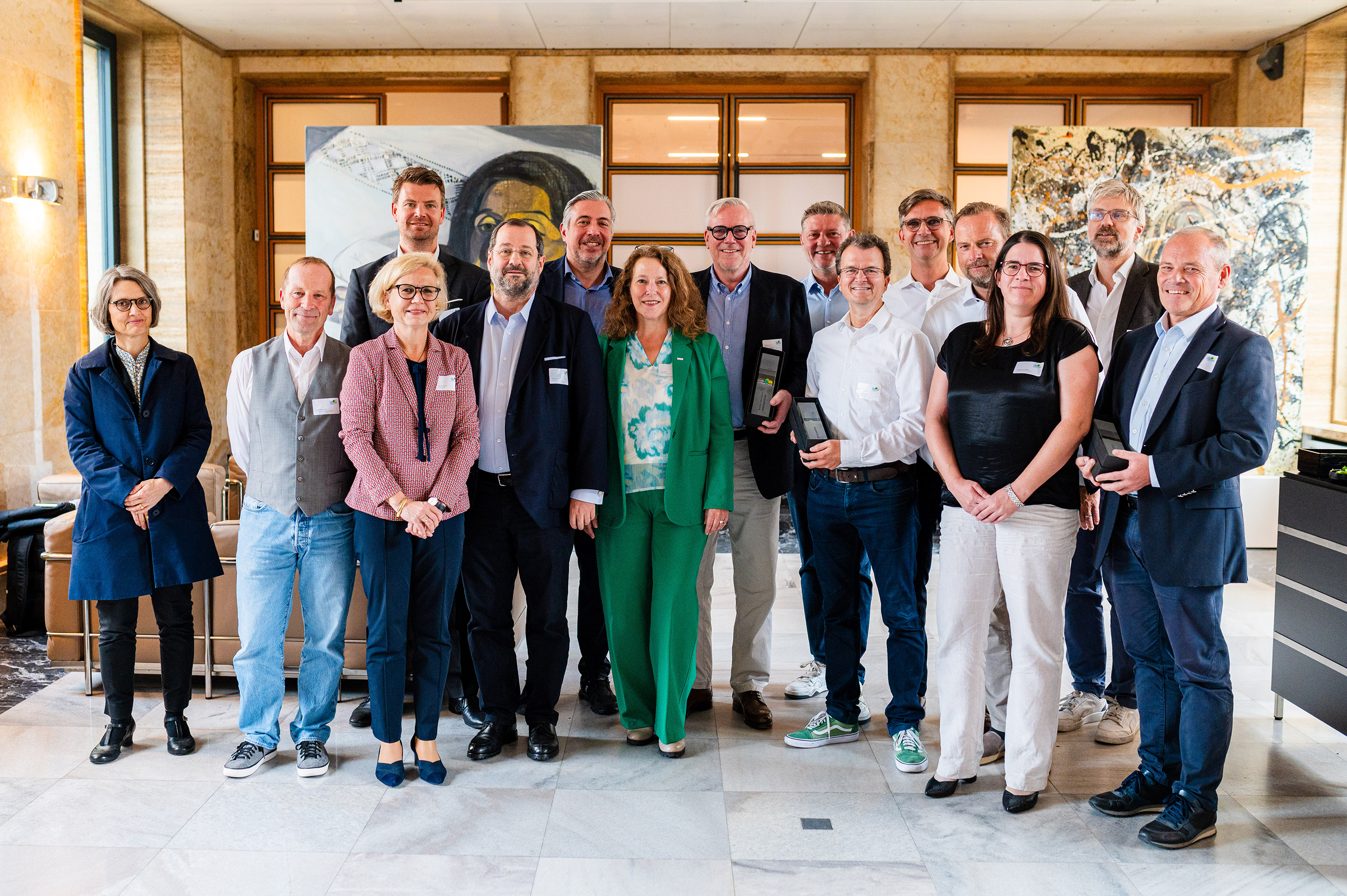
With the Construction Contest, Vonovia and BUWOG joined forces in 2024 with start-ups and companies from the DACH region to identify new construction solutions that combine lower resource use with competitive costs. Around 100 companies submitted ideas for building materials, constructions and production techniques, particularly for prefabrication and modular construction methods. A panel of experts from industry and research selected, among others, load-bearing clay bricks, a drywall system made from straw, aerogel insulation materials and “climate-positive” precast concrete elements with an emissions profile that differs from conventional products. The award-winning solutions are now being assessed for potential use in BUWOG construction projects. More information on the Construction Contest is available here.
Vonovia also promotes innovation in construction through the “Perspectives on the Future of Construction” dialogue process. Since 2022, this initiative has been bringing together stakeholders from industry, research and politics to develop approaches to construction methods that address greenhouse gas emissions and resource consumption. Working groups with industry experts and the Fraunhofer Institute have developed concrete courses of action, which are being translated into measures and targets and also provide input for shaping the political framework.
Responsible construction site management is a key priority for us. In matters of occupational health and safety, we follow the requirements of the German Occupational Health and Safety Act (ArbSchG) and appoint safety coordinators to reduce health risks for employees and impacts on the surrounding neighbourhood – for example through noise and dust. These requirements apply without exception to our general contractors and subcontractors as well.
In the area of waste management, we comply with the provisions of the German Circular Economy Act. Separate collection of waste streams enables better control of disposal costs; corresponding requirements are embedded in our tender specifications.
When planning construction projects, we examine at an early stage, in line with the German Federal Nature Conservation Act, whether protected species may be affected. Our internal guidelines (for example on the preservation of trees) supplement the statutory framework in order to protect endangered plants and animals in the immediate vicinity of our construction projects.
Mobility offerings are another key component of our development approach. In our projects, we place importance on providing diverse, easily accessible options that cater to different mobility needs. One example is the completion of the Helio Tower in the “The Marks” urban development area in Vienna. It features a cross-site bicycle arcade with space for 2,000 bicycles, 652 of which are designated for the Helio Tower. On average, 1.8 bicycle parking spaces were available for each newly built apartment.
In addition, a car-sharing scheme with electric vehicles, city bikes and electric cargo bikes is available. The BUWOG garage area also offers up to 27 electric charging stations with load management. On average, our new-build projects completed in the reporting year are located around a four-minute walk from public transport, ensuring that these mobility options are easy to reach.